Where the Data Comes From
LobbyWatch: Mississippi uses publicly available records to make information about lobbying and political influence easier to find and understand.
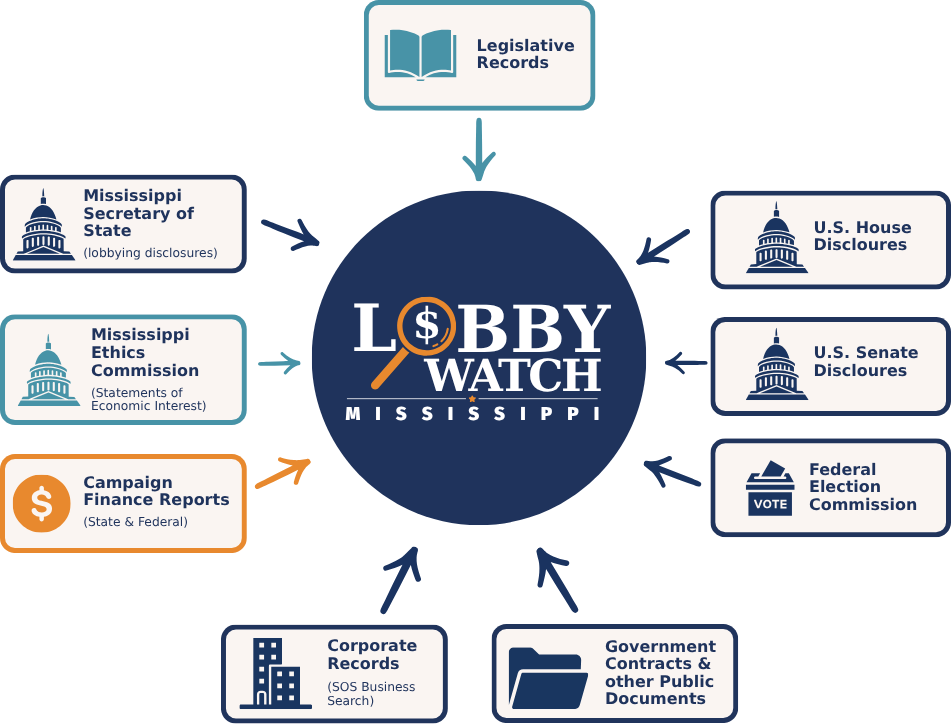
State lobbying data comes primarily from registrations and reports maintained by the Mississippi Secretary of State. Federal lobbying data comes from reports filed under the federal Lobbying Disclosure Act and published through U.S. House and Senate disclosure systems.
When relevant, we may also use campaign-finance reports, Statements of Economic Interest, corporate records, legislative records, government contracts, and other public documents.
How We Organize the Data
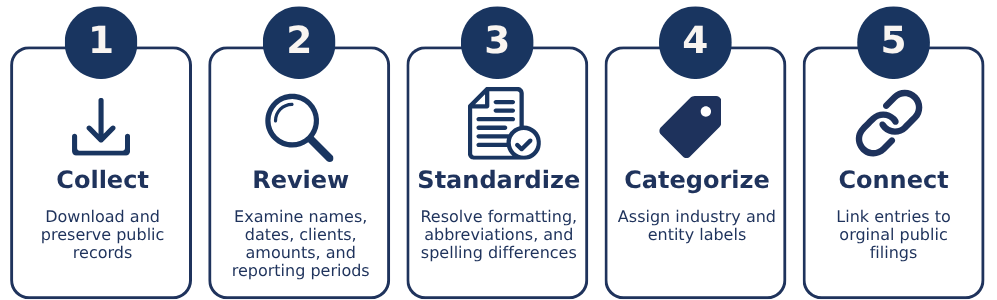
Public records are not always published in a consistent or searchable format. Our research team collects and reviews the available filings, then standardizes information such as:
- Names of lobbyists, companies, organizations, and public officials
- Dates and reporting periods
- Reported expenditures and other monetary amounts
- Client and lobbying-firm relationships
- Industry categories
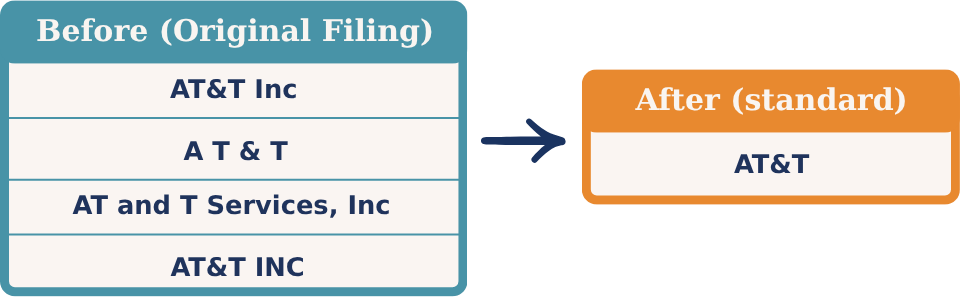
We may correct obvious formatting differences, abbreviations, or spelling inconsistencies so that records involving the same entity can be found together. Whenever possible, entries remain connected to the original public source.
Lobbying entities are categorized as follows:
LobbyWatch: Mississippi synthesizes data by grouping companies and organizations into broad industries so users can compare lobbying activity across different sectors. Categories are assigned based on an entity’s primary work, the interests it represents, and information available through official records and reliable public sources. An entity may be included in more than one industry when its work overlaps multiple sectors. Because categories may overlap, industry totals should not be added together to calculate total lobbying spending. Doing so could count the same record more than once.
You Can View All Categories & Definitions Here:
Aerospace & Defense
Companies and contractors involved in manufacturing aircraft, defense systems, and related technology, often lobbying for federal contracts allocated to Mississippi facilities and favorable state procurement policies.
Agriculture & Food Production
Farm bureaus, commodity groups (e.g., cotton, soybeans, poultry), food processors, and related associations, often advocating on issues like water rights, land use, subsidies, environmental regulations, and food safety standards.
Alcohol, Tobacco & Firearms
Distillers, breweries, tobacco companies, and firearms dealers or manufacturers, often lobbying on taxation, distribution laws, licensing, and regulations specific to their products.
Automobile & Transport
Automobile dealers, manufacturers, trucking companies, and transportation services, often lobbying on vehicle sales regulations, fuel taxes, infrastructure spending, and highway safety laws.
Banking & Financial Services
Banks, credit unions, payday lenders, and financial institutions, often focused on state banking regulations, consumer lending laws, interest rates, and financial oversight.
Business Chamber / Trade Association
Umbrella organizations like the Mississippi Manufacturers Association or industry-specific trade groups that represent the collective interests of a broad business community or a particular sector.
Chemicals
Manufacturers of industrial and agricultural chemicals, often lobbying on environmental permitting, safety regulations, and tax incentives.
Construction & Real Estate
Home builders, contractors, real estate developers, and realtor associations, often advocating for building codes, zoning laws, infrastructure projects, tax credits, and property rights.
Consulting
Firms providing business advisory, staffing, tax, management, or human resources services. These entities may lobby on issues affecting professional services, such as state contracting rules, business tax codes, employment and labor regulations.
Consumer Goods
Companies that manufacture or sell non-durable household products, often focusing on packaging regulations, sales taxes, product safety laws, and labeling requirements.
Education
Public school districts, charter school advocates, private universities, and teacher organizations, which may lobby on K-12 funding, education budgets, curriculum standards, and education policy reforms.
Energy
Oil and gas companies, renewable energy firms, and pipeline operators, often lobbying on extraction regulations, energy infrastructure, tax incentives, and environmental policies.
Forest Products
Timber companies, paper mills, and forestry associations that may advocate for timber rights, land management policies, forestry regulations, and transportation logistics for wood products.
Gambling
Casinos, lottery vendors, and related interests, which may lobbying on gaming regulations, tax rates, license renewals, and the expansion of gambling activities.
Healthcare
Hospitals, nursing homes, physician groups, and medical associations, often lobbying on Medicaid reimbursement rates, scope-of-practice laws, healthcare facility regulations, and public health funding.
Hospitality
Hotels, restaurants, and tourism boards focused on issues like tourism promotion funding, food service regulations, alcohol licensing, and hotel taxes.
Information Technology
Software companies, data centers, and tech service providers which may be advocating for data privacy laws, broadband expansion, cybersecurity regulations, and tax policies for tech investments.
Insurance
Property and casualty, health, and life insurance companies, often lobbying on state insurance regulations, premium rates, claims processes, and healthcare reform.
Law Enforcement & Prisons
Police unions, sheriff’s associations, and private prison companies, often advocating for criminal justice legislation, sentencing laws, equipment funding, and correctional facility contracts.
Law Firm
Legal firms that advocate on legislative and regulatory matters, often for a diverse set of corporate or institutional clients.
Local Government
Municipalities and counties which may be lobbying for local revenue authority, infrastructure grants, and other funds from the state legislature.
Lobbyists
This typically refers to lobbying firms, registered as the official agents advocating before government officials.
Manufacturing & Industrial Equipment
A broad category covering factories and industrial suppliers, often advocating for workforce training programs, tort reform, tax exemptions for equipment, and regulatory relief.
Media & Entertainment
Broadcasters, publishers, and entertainment venues, often lobbying on issues like intellectual property, broadcasting rights, and advertising taxes.
Mining
Companies involved in sand, gravel, and other mineral extraction, often focused on permitting processes and environmental regulations.
Nonprofit
501(c)(3) organizations that may be advocating for social services, environmental causes, arts funding, or humanitarian issues.
Pharmaceuticals
Drug manufacturers and pharmacy owners, often lobbying on drug pricing, prescription drug regulations, and laws affecting pharmacy operations.
Philanthropy
Foundations and charitable organizations that may lobby to influence policy related to their grant-making focus areas, such as education or community development.
Political Advocacy
Issue-based groups lobbying for or against specific legislation, typically aligned with ideological causes (e.g., gun rights, abortion, environmental activism).
Professional Association
Licensing boards and associations for specific occupations (e.g., engineers, nurses, accountants), which may lobby on licensing requirements, education rules, and scope-of-practice legislation.
Retail
Big-box stores, grocery chains, and retail merchants, advocating on issues such as sales tax, inventory tax, labor laws, and business operation regulations.
Semiconductors
Companies involved in the microelectronics supply chain, a growing category as the state attracts manufacturing, often lobbying for tax incentives and workforce development.
Shipping
Shipping companies and logistics firms, often lobbying for port infrastructure funding and transportation regulations.
State Government
State agencies or commissions that may lobby the legislature directly for their budgetary needs, operational authority, and policy priorities.
Telecommunications
Telephone companies, cable providers, and internet service providers, often lobbying on broadband deployment, right-of-way access, and state telecommunications law.
Think Tank
Research organizations that produce policy analysis and advocate for specific economic, social, or political reforms based on their ideological orientation.
Utilities
Electric, water, and natural gas companies (e.g., Entergy Mississippi), often lobbying on rates, infrastructure investments, and regulatory oversight.
Union
Labor organizations representing workers, often advocating for collective bargaining rights, wage laws, workplace safety, and benefits.
Waste Management
Landfill operators, recycling companies, and hazardous waste disposal firms, often lobbying on environmental regulations and state contracts for waste services.
Note: Each company or organization was classified according to one or more industry categories, when deemed appropriate. As a result, contributions by industry should not be used to sum total lobbying expenses. Adding industry totals together would count overlapping contributions multiple times, leading to an inflated total.
Understanding the Records
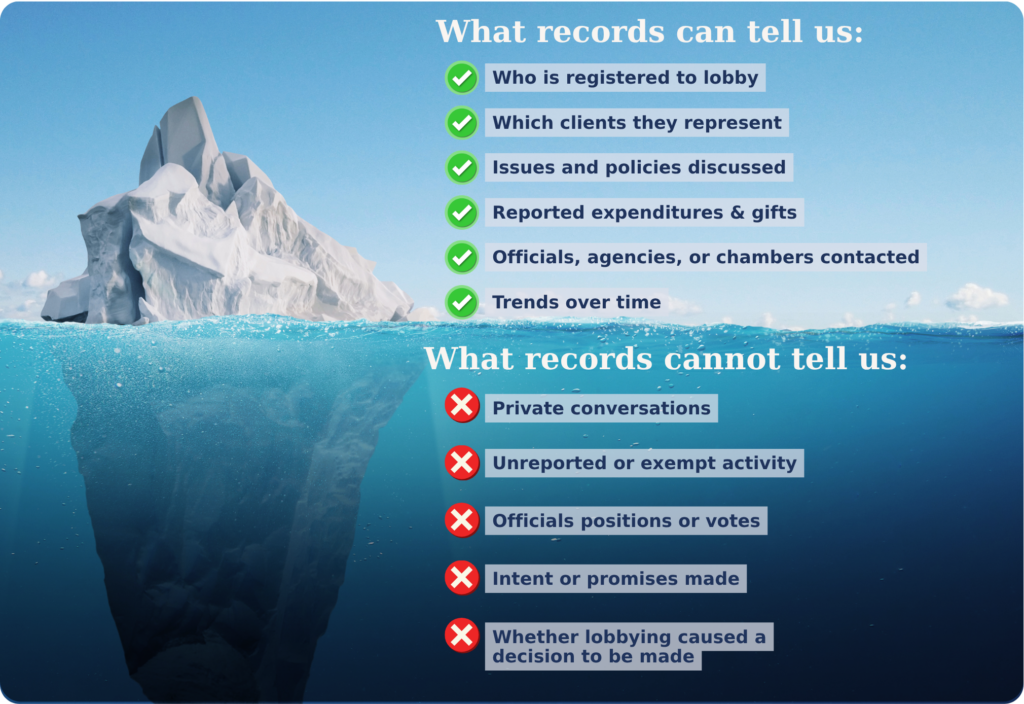
Lobbying records can help identify who is registered to lobby, which clients they represent, what amounts were reported, and which industries appear most frequently in the data. However, the records do not capture every form of political influence.
A person or organization appearing in the database does not prove bribery, corruption, or that lobbying caused a particular vote or government decision. This database simply tells us what lobbyists have reported lobbying activities for our elected officials, and LobbyWatch: Mississippi’s research to create aggregate data analysis simply helps us understand trends in industry lobbying patterns across different elected officials.
The absence of a record also does not prove that no communication or advocacy occurred. This data offers one piece of the puzzle on how industry and entities influence and advocate to elected officials in our state
You can find original sources by visiting the following:
State Sources:
- Statement of Economic Interest (Mississippi Ethics Commission)
- Corporate Business Search (Mississippi Secretary of State)
- Lobbying Disclosure (Mississippi Secretary of State)
- Campaign Finance Reports (Mississippi Secretary of State)
Federal Sources:
- U.S. Senate Financial Disclosures
- U.S. Senate Lobbying Disclosures
- U.S. House Financial Disclosures
- U.S. House Lobbying Disclosures
- Campaign Finance Reports (U.S. Federal Election Commission)
Other Sources:
Corrections, Sources, and Updates
Lobby Watch Mississippi is an educational and research project. The original government filing remains the authoritative source.
Each database or visualization should identify the reporting period covered and the date of its last update. Records may change when agencies publish new filings or amendments.
To report a possible error, please send us the page or record involved, a description of the issue, and supporting public documentation.